
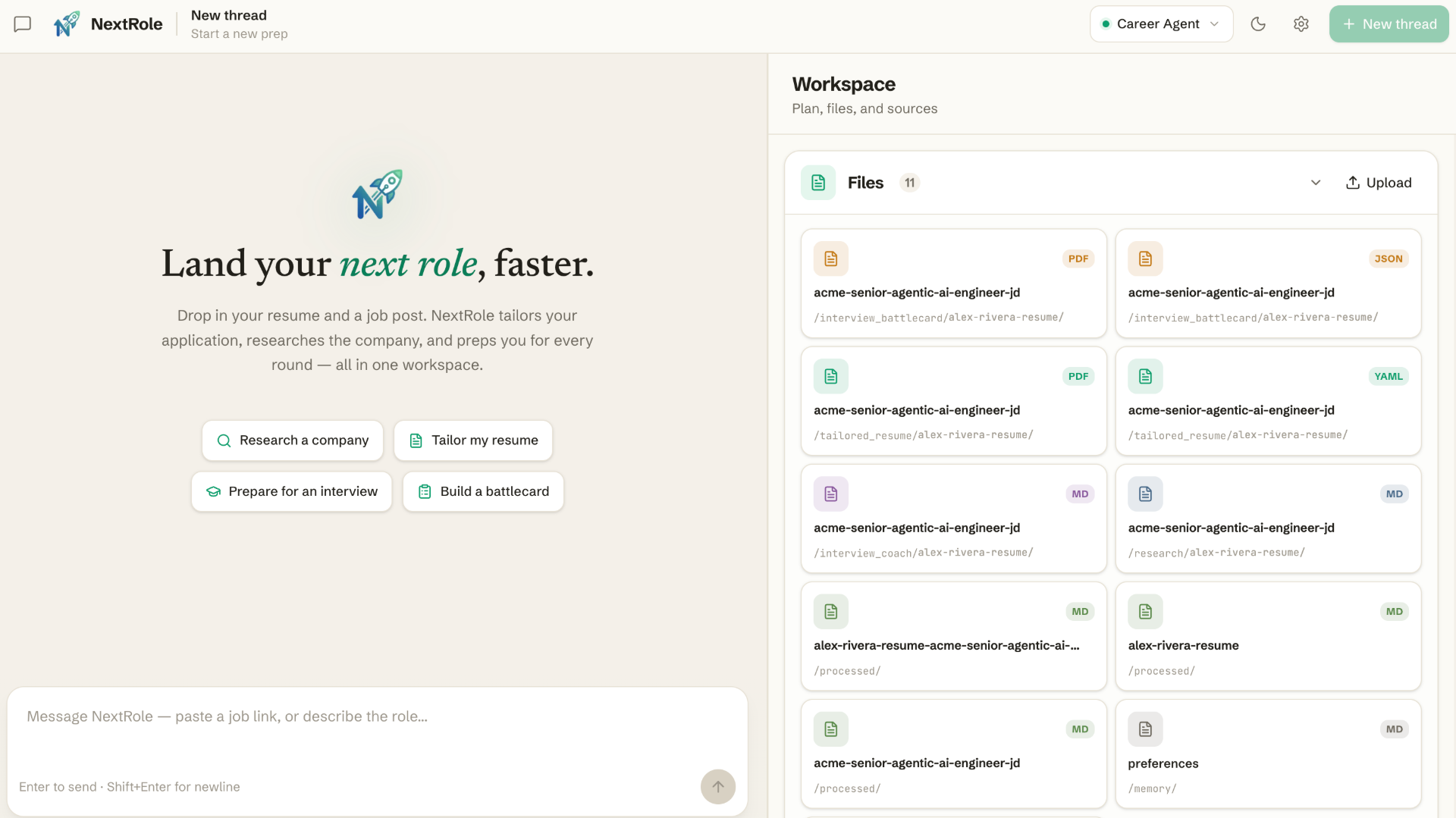
Tailored resume
Your experience rewritten to match the JD and the company's language, rendered
to a clean PDF with rendercv. The YAML source stays
editable and re-renderable.
Upload your CV and a job description. A team of AI agents researches the company, rewrites your resume to fit, coaches you round by round, and prints a one-page cheat sheet for interview day.
docker compose up -d
runs the whole stack on your own machine.
Not generic advice. Every file is written against the exact job description and the company research the agents just did, and you can keep editing it in chat.
Your experience rewritten to match the JD and the company's language, rendered
to a clean PDF with rendercv. The YAML source stays
editable and re-renderable.
A self-introduction and STAR stories mapped to every interview round, grounded in live research on the company and the role, plus a prep plan sized to the time you have.
One page per round for the final high-pressure review: the questions to expect, your strongest stories, and the questions you'll ask them.
The career agent runs the pipeline and delegates the specialist work. Tailoring and coaching run in parallel, and follow-up edits go straight to the agent that owns the file.
Your CV, the JD as a file, URL, or text, your timeline, and any extra context.
Uploads parsed to Markdown; JD pages extracted from the link.
Company and role intel distilled into a match analysis.
CV rewritten as rendercv YAML, rendered to PDF.
Self-intro and per-round STAR stories.
One page per round, assembled and rendered to a day-of PDF.
Ask for changes in chat. The owning agent updates the file and re-renders.
Edits don't rerun the pipeline. "Add a fourth round" goes to the interview coach; "add React to my skills" goes to the resume tailor. Each one reads the existing file, preserves everything you didn't name, and re-renders.
Each specialist is declared in a YAML file with its own model, tools, and skills, and only receives the tools it opts into. Watch them work in 72 seconds.
coordinator
Runs intake, parses your documents, delegates, and assembles the battlecard.
research
Live web research on the company and the role, distilled into a match analysis.
writing
Rewrites your CV against the JD and research, then renders the PDF.
coaching
Writes the self-introduction and STAR stories for every round.
A second analytics agent in the agent switcher answers questions about
the product itself with read-only SQL and charts.
See how it works.
A second agent in the agent switcher answers questions about activity, reliability, tool usage, and LLM cost. It queries a warehouse rebuilt every hour from the app's own data, and answers with a chart.
describe_data
Merges dbt column descriptions, Cube metric definitions, and the ClickHouse schema before writing any SQL.
run_sql
A dedicated warehouse login with SELECT on the marts and staging layers only, under query limits it cannot raise.
create_chart
Line, bar, heatmap, table, KPI, and more, stored with the conversation so they redraw when you reopen the thread. Custom Plotly charts go through an approval-gated Python step.
It reads activity across users, so access is an explicit allowlist. The pipeline copies structure and metrics, never chat, CV, or JD bodies. Watch the analytics demo.
The career agent and its three specialists, from CV and job link to three documents, plus the analytics agent, in 72 seconds.
Prefer YouTube? Watch it in HD there.
# 1. clone and configure $ git clone https://github.com/tam159/next-role.git $ cd next-role $ cp .env.example .env # add your API keys # 2. launch everything: frontend, agents, Postgres, # Redis, object storage, analytics $ docker compose up -d # 3. open the app $ open http://localhost:3000
Prefer to keep it in-house? NextRole is MIT-licensed and runs end to end on your own machine, so your CV and your data never leave your infrastructure.
Sign in with Google and prep for your next interview today. It's a free beta with daily usage limits, and the whole thing still runs on your machine with one command.